

Welcome to this blog post (7 minute read). In the podcast version (listen below or on Apple podcasts), two AI hosts do a fantastic job of deep-diving into this “human-written” post (17 minutes). Honestly, they really blow me away with how they talk about it! I hope you enjoy. Please let me know your thoughts. Jan
You’re on your laptop, clicking through websites, streaming a show, checking your emails. You might call it all “the Internet.”
Yet, did you know the Internet and the World Wide Web (“Web”) aren’t the same thing?
If you’ve never stopped to think about the difference, well, you’re not alone!
Most people use the terms “Internet” and “Web” interchangeably; we’ve been doing it for decades.
But they’re not the same thing. Now, with the arrival of AI agents, decentralised platforms, and the next version of the World Wide Web (Web3) on the horizon (although we haven’t quite figured out what Web3 looks like yet), knowing the difference is becoming more critical than ever.
And no, this isn’t just tech trivia. This distinction could shape how we communicate, access knowledge, and collaborate in the years ahead.
Stay with me.

What is the Internet (simply and briefly!)
The first thing to know is that the Internet came before the World Wide Web.
In the 1960s, the Internet was a system that (initially) used leased telephone lines and modems to transmit data from one computer to another. A group of connected computers is called a network, so it’s easy to see how the name emerged from “interconnected networks” → Internet. (I use that kind of word origin to help me remember things!)
The official birthday of the Internet is said to be 1983. I have a daughter born that year so, for me, it doesn’t feel that long ago 🙂
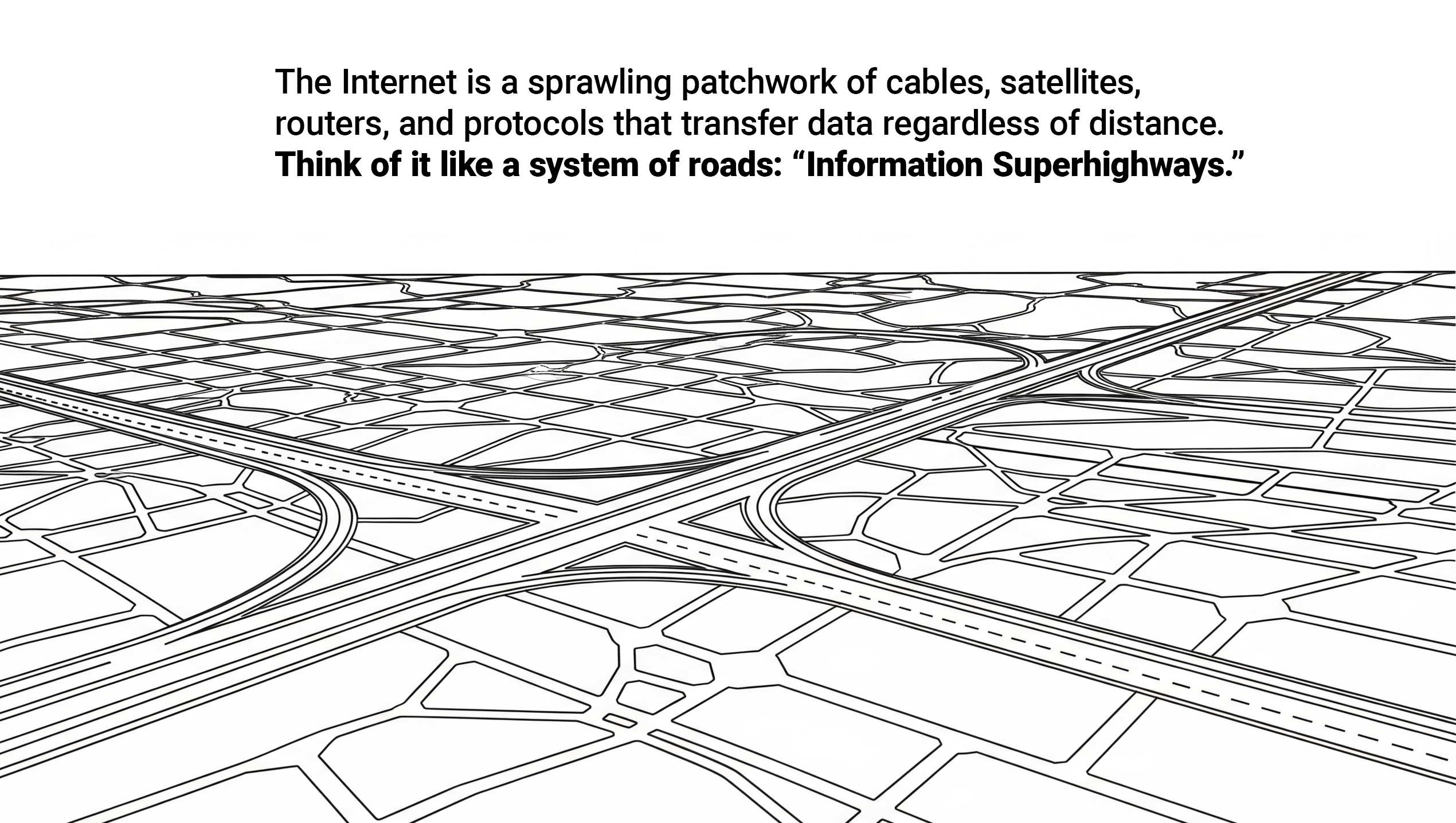
Today, the Internet is a sprawling patchwork of cables, satellites, routers, and protocols (which are sets of rules) that transfer data regardless of distance. One way to visualise the Internet is as a system of roads. You may have heard people refer to it as the “Information Superhighway.”
Hello, World Wide Web
I love the story of the World Wide Web (also called WWW, W3, or simply the “Web”). Yes, it’s technology, but for me, it represents our humanity. Let me explain.
Before the Web came along, using the Internet meant manually typing long and complicated addresses (URLs) to access information. It was slow and prone to errors.
Then, in 1989, a British computer scientist named Tim Berners-Lee proposed a way to link and access information more easily.
At the time, he was working at CERN (the European Organisation for Nuclear Research), and wanted to help scientists around the world share knowledge. His solution?
A “hypertext project” called WorldWideWeb, in which a web of linked documents could be viewed through “browsers.”
It was revolutionary thinking.
The “Web” is Just One Way We Use the Internet
Imagine the World Wide Web as a vast network of buildings, libraries, cafés, galleries, and offices, all of which you can reach by travelling along those “Internet” roads.
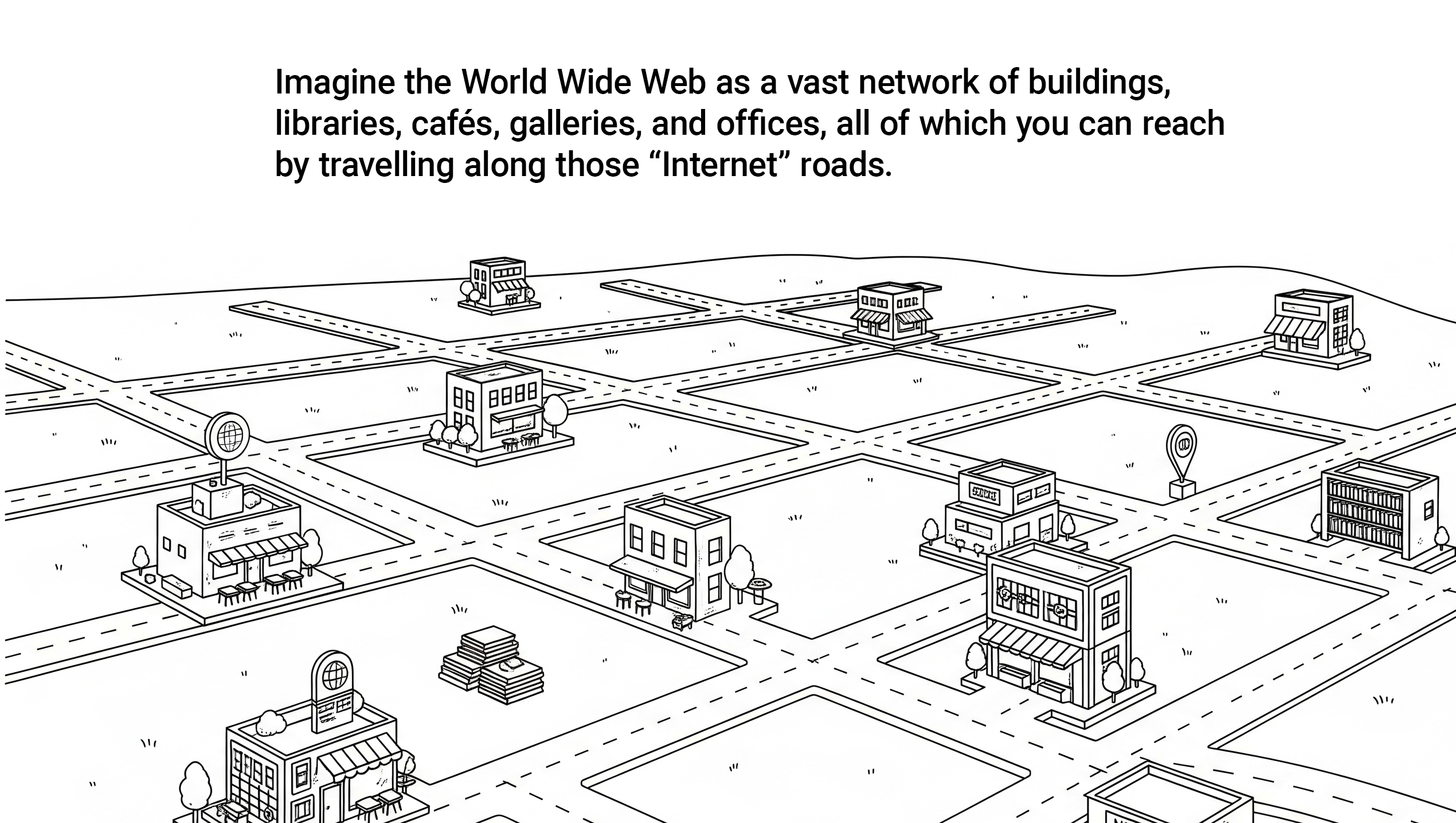
For example, when you open a browser and type in a web address, you’re essentially stepping into one of those buildings.
But this is where many people get confused.
Many areas of the Internet are not part of the World Wide Web.
Today, the Internet powers all kinds of applications such as messaging apps, email services, cloud storage, games, and even AI tools.
For instance:
-
Email is part of the Internet, but it is not part of the World Wide Web.
-
Netflix uses the Internet, but not necessarily the Web.
-
Apps like WhatsApp or Zoom operate over the Internet, often outside of a web browser.
You’re reading this blog post through a web browser window, such as Chrome or Safari, which means you’re on the World Wide Web. However, you’re using the Internet to access it.
Why This Matters for Non-Designers
So, why does this matter? Do you really need to know the difference between the Internet and the Web?
Yes. You do.
Let’s say you’re a mid-career professional in business, education, communications or any field, really. Digital literacy isn’t just about using tools or learning to code. It’s about having some understanding of the systems behind our technology.
It helps you ask better questions:
-
Where does this information live?
-
Who controls the platform I’m using?
-
What happens when the infrastructure fails?
Even understanding the difference between the Web and the Internet gives you a clearer mental map one that’s increasingly useful as these systems evolve.
The “Web” Was a Gift (Literally)

This is my favourite part of the Web’s history:
In 1993, Berners-Lee and CERN released the Web’s foundational code into the public domain.
They made it freely available for anyone, anywhere to use, adapt, and build upon.
That means:
-
No patent.
-
No licensing fee.
-
No financial gain for them.
Just a gift to humanity.
(Hard to imagine that now, isn’t it?)
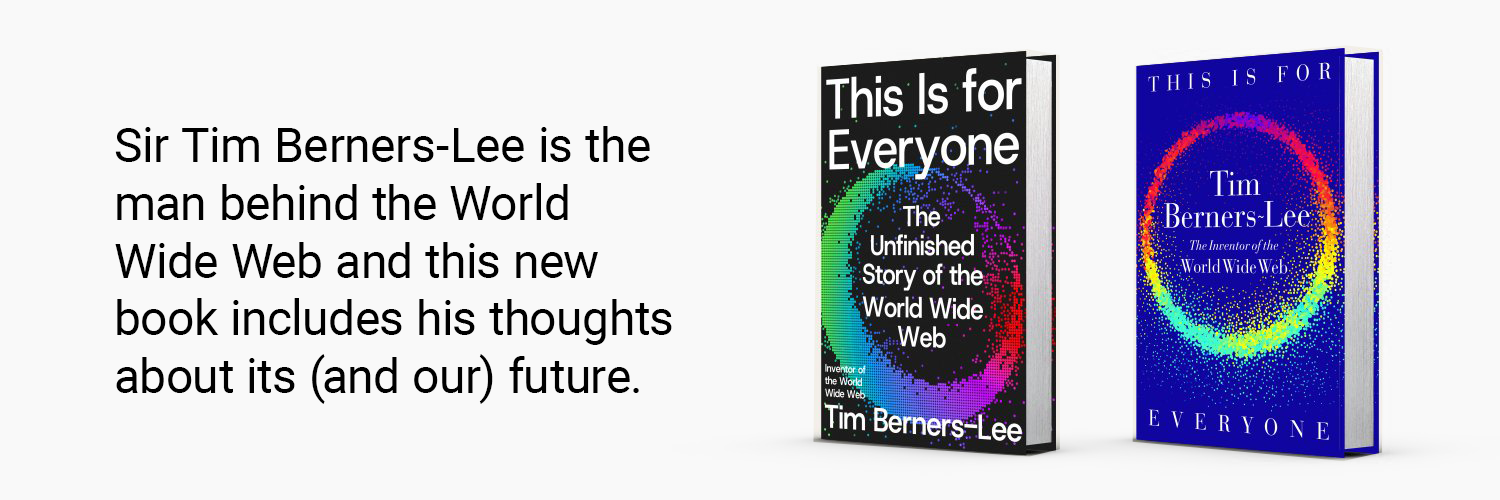
I’m glad to say that Queen Elizabeth II knighted Tim Berners-Lee in 2004 for “services to the global development of the Internet.” His autobiography, This Is for Everyone, is scheduled for release in September 2025, and I am keen to read it. (I have no affiliation with the book or author; I’m just mentioning it!).
Now We Have AI Agents
Fast-forward 32 years, and the future is arriving at an almost alarming pace.
Just days ago, OpenAI introduced a new feature: ChatGPT Agents. Their technology is part of what is being called Agentic AI.
These AI “agents” are more than just chatbots; they can proactively complete tasks on your behalf. Think of it as an intelligent assistant that not only answers your questions, but takes action.
ChatGPT Agents can create presentations, plan trips, book reservations even while you’re away from your screen!
It’s not just about using the Internet anymore; it’s about delegating interaction with it.
How does Agentic AI work?
These agents still use both the Internet and the Web, but they’re changing how we interact with both.
In ChatGPT, for instance, the agent uses a browser within a browser; now you know that’s the Web. However, the “agent” also utilises APIs and data streams beyond the Web’s visual layer.
(APIs, or Application Programming Interfaces, are rules that help different software systems talk to each other and share data. For example, when you check flight details on various websites, they use APIs to connect to the airlines’ information. Just in case you were wondering.)
As I keep saying: Hold onto your hat, the future is nearly here! This is especially relevant when considering that ChatGPT was only released in November 2022.
Let’s Shift Our Thinking
The future isn’t (yet) about whether the Web or the Internet will disappear; it’s about how we adapt as they fragment, evolve, or shift beneath us.
We may not be able to predict where it’s all going. But we can prepare for it by paying closer attention to the digital tools we use and the infrastructure behind them.
So next time you say, “I saw it on the Internet,” pause for a moment.
Was it on a website? A Zoom call? A message in an app?
That small act of curiosity can expand your design and digital literacy.
Next time you talk about AI, be specific: What kind of AI?
More on that to come.
Until next time, remember to embrace your design abilities!
Jan
Curious about what comes next?
🎙️ Subscribe to my podcast, “Mind Your Gaps” where two AI Hosts discuss my blog posts; it’s surprisingly fun to listen to! You can find this episode on Apple Podcasts.📬 Sign up for my (sort of) regular newsletter, Design-Speak, for more insights delivered without the jargon. Sign up form is at the bottom of the page.
Images: I create all the images using a combination of software. For these I used Gemini, Adobe Photoshop and and Adobe Illustrator (© 2025).

Love this!
Thank you for commenting!
Thank you! x
Absolutely wonderful